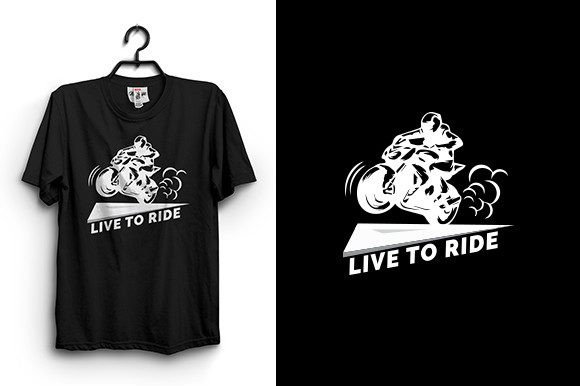
The Live to Ride T-Shirt Design: Navigating Quality and Flexibility for Custom Apparel
For anyone venturing into custom apparel, whether as a small business owner, a merchandise creator for a club or event, or simply for a personal project, the quality and adaptability of the design file is paramount. The phrase "Live to Ride" evokes a spirit of freedom and passion, often associated with motorcycle culture, outdoor adventure, or a general zest for life. A Live to Ride T-Shirt Design that captures this ethos isn't just about the slogan; it's about the technical foundation that allows the idea to be translated onto fabric effectively and efficiently.
Understanding the Core Value: What Makes This Design Distinct
When evaluating a t-shirt design purchase, especially one advertised with features like easy editing and high-quality files, the distinction often lies in the file format and scalability. A typical Live to Ride T-Shirt Design offering, as described, centers on being a vector-based asset. Vector graphics, created in programs like Adobe Illustrator, are defined by mathematical paths rather than pixels. This is the key to the promise of being "easily changed without losing any quality." You can resize the design from a small logo on a pocket to a full-back print without any degradation, blurring, or pixelation.
This contrasts sharply with standard raster images (like common JPEGs or PNGs), which are resolution-dependent. Enlarging a low-resolution raster image for a t-shirt print often results in a fuzzy, unacceptable outcome. Therefore, the primary value of this type of Live to Ride T-Shirt Design package isn't merely the aesthetic of the text or accompanying artwork, but the professional-grade, editable digital file that comes with it.
Comparing Design Delivery: Files, Formats, and Practical Use
A closer look at the provided specifications reveals a comprehensive suite of files. The inclusion of AI, EPS, SVG, high-resolution PNG, and a 4500×5400 px file speaks to a bundle designed for versatility. Let’s break down what each means for a potential user and how this compares to other common offerings in the marketplace.
Vector Formats: AI, EPS, and SVG
The AI (Adobe Illustrator) and EPS files are standard in professional design circles. They allow complete deconstruction of the Live to Ride T-Shirt Design. You can change colors, as noted, from black and white to full color. You can alter font styles if the text is outlined, modify graphic elements, or isolate components. The SVG file is useful for web-based applications or certain modern printing software. Having all three covers nearly every professional and semi-professional editing scenario.
High-Resolution Raster Fallbacks: PNG at 300dpi
While the vector files are for editing, the high-resolution PNG at 300 dots per inch (dpi) serves as a ready-to-use, rasterized version. For those without vector software or when using a print service that requires simple image uploads, this file is crucial. The specified 4500×5400 px dimensions ensure it can be printed very large at high quality. This dual offering—vector for editing, high-res raster for direct use—addresses two major user profiles: the customizer and the quick implementer.
The Trade-off and Fit Assessment
Not every design purchase requires this level of file depth. If your need is for a single, one-time print of a fixed design, a simple high-resolution PNG might suffice from another source. However, the trade-off is permanent inflexibility. The Live to Ride T-Shirt Design package, with its vector core, is best-fit for situations where:
- Adaptation is expected: You plan to use the design across different products (t-shirts, hoodies, caps) or in various color schemes.
- Brand cohesion matters: You might want to integrate the "Live to Ride" motif with other logos or text for a club or business.
- Future edits are possible: Seasonal promotions, event-specific versions, or simply a change in personal taste.
If your project is static and one-off, and you lack the software or desire to edit, the extensive vector files may be less utilized, though the included PNG still provides excellent print quality.
Decision Factors: When This Design Package is the Right Choice
Choosing a design resource involves weighing several factors beyond the immediate appeal of the artwork. For the Live to Ride T-Shirt Design bundle, consider these points.
Technical Capability and Software Access
The premier benefit—editing without quality loss—requires access to vector editing software like Adobe Illustrator or a compatible alternative (CorelDRAW, Inkscape, etc.). If you have this, the package unlocks its full potential. If you don't, your primary asset becomes the high-resolution PNG and SVG files, which are still valuable but limit the "easy change" promise to using simpler tools for basic color swaps, if the file structure allows.
Scale of Your Project
For an individual making a few shirts for friends, the comprehensive file set might be more than necessary. For a small business planning to sell "Live to Ride" merchandise, it is a prudent investment. The organized, layered vector file can speed up production variations, ensuring consistency across a product line. The delivery of 100 vector designs (as mentioned in the broader store context) suggests a store geared towards bulk or frequent creators, where such organization saves significant time.
Comparison to Marketplace Alternatives
In online marketplaces, you'll find designs sold as:
- Single raster images (JPEG/PNG): Lower cost, but fixed size and limited editability.
- Simple vector files (SVG only): More flexible than raster, but may lack the layered, professional structure of an AI file.
- Full vector bundles (AI, EPS, etc.): Similar to this Live to Ride T-Shirt Design offering, often at a higher price point, reflecting the professional utility.
The decision hinges on your need for that professional utility. The inclusion of both the 300dpi raster image and the full vector suite in one package attempts to bridge the gap for users at different technical levels.
Realistic Applications and When to Look Elsewhere
Imagine a motorcycle club that wants "Live to Ride" as its official merchandise tagline. They might want the design in black and white for a standard shirt, in full color with club logos integrated for a special event shirt, and as a small left-chest logo on a polo. This scenario perfectly aligns with the strengths of this editable Live to Ride T-Shirt Design. The club's designer can efficiently produce all variants from one master file.
Conversely, consider a gift buyer who wants a single, premade "Live to Ride" shirt for a friend. They have no interest in editing, no design software, and no plans for volume printing. For them, purchasing a physical shirt from a retailer or a ready-to-print file from a service that specializes in simplified, direct-to-print uploads might be a more straightforward path. The design bundle's value is proportionally tied to the scale and customization intent of the project.
Limitations and Considerations
Even with high-quality files, final print results depend on the printing method used (DTG, screen print, heat transfer) and the printer's skill. The design files are a starting point. Also, "easy editing" assumes a baseline competence with design software; complex edits still require skill. Furthermore, while the text "Live to Ride" is versatile, the specific artistic style of the accompanying graphics (if any) in the design will determine its fit for your audience. A bold, gritty font might suit a biker community, while a sleek, modern one might appeal to a travel or adventure brand. Assessing the provided aesthetic against your target market is as important as assessing the file specs.
Making an Informed Selection for Your Needs
Evaluating the Live to Ride T-Shirt Design offering, or any similar design resource, requires a clear view of your project's lifecycle. Are you buying a finished product, or are you buying a raw material for your own production? This bundle is unequivocally the latter—a high-quality raw material.
Its strengths are undeniable for the customizer and the scale-oriented creator: organization, format completeness, and scalability. Its trade-off is potential complexity for the non-technical user and possibly a higher relative cost if only the raster image is used. By understanding the difference between vector and raster, and honestly assessing your own needs for adaptation, scale, and technical access, you can determine if this type of design package is the optimal resource for your "Live to Ride" apparel project or if a simpler, more fixed alternative better matches your immediate goals.